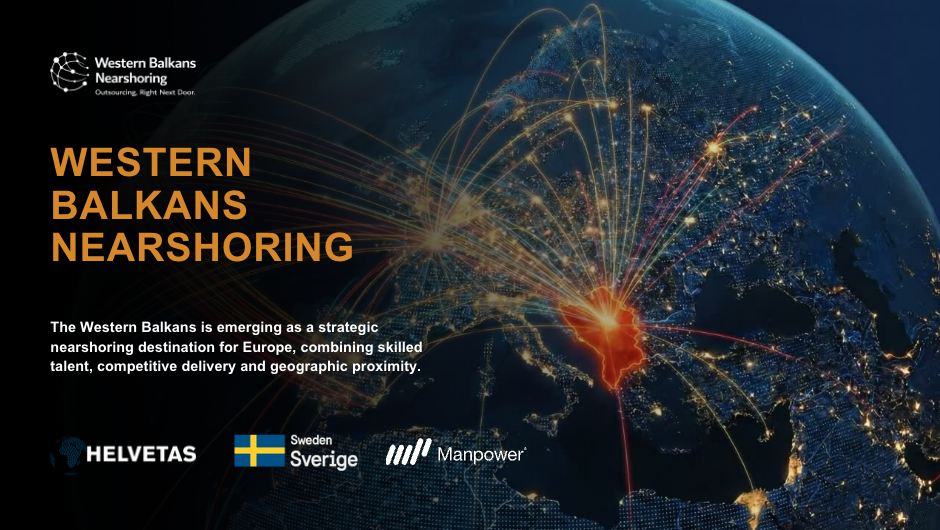
Beyond Outsourcing: Building Integrated Engineering Teams in the Western Balkans
For European companies facing shortages of specialised engineering talent, nearshoring can provide access to additional capacity without moving work far from core markets.
But in engineering and digital transformation, capacity alone is not enough.
The work is often complex, collaborative and closely connected to existing technical processes. Companies therefore need more than an external supplier capable of completing predefined tasks. They need teams that can understand project requirements, work within established systems and contribute effectively alongside internal specialists.
The experience of Walter AEC, which has connected Scandinavian clients with engineering teams in Bosnia and Herzegovina for more than a decade, provides a practical example of how this model can work.
In this video, Adna Dučić, Marketing Manager at Walter AEC, discusses why the Western Balkans can compete as a destination for engineering and digital transformation, what international clients discover once cooperation begins, and why companies from Northern and Western Europe should take a closer look at the region.
Engineering nearshoring is a capability question
Cost and access to talent are usually among the first factors considered when companies evaluate a nearshoring location. For engineering projects, however, the more important question is what that talent can actually deliver.
Architecture, BIM, civil engineering, mechanical and electrical engineering and related digital services increasingly require professionals who can operate inside sophisticated project environments, understand international requirements and collaborate across disciplines. This changes the economics of nearshoring. The objective is not simply to relocate individual tasks to a lower-cost market. The stronger opportunity is to extend an organisation's technical capacity by adding professionals who can become part of the wider delivery team. When that happens, nearshoring becomes less about outsourcing work and more about building capability.
The quality of collaboration matters as much as technical expertise
A technically strong team can still create problems if communication is slow, expectations are misunderstood or collaboration requires constant management from the client. This is particularly important in engineering, where decisions made by one team can affect multiple other parts of a project. Nearshoring within the Western Balkans offers an important practical advantage in this respect. Teams operate within European working hours, international travel is relatively straightforward and communication can take place with significantly less time-zone friction than in many offshore models.
But proximity should not be understood only in geographical terms. The ability to communicate clearly, adapt to established workflows and understand how international clients operate can be just as important as physical distance. For companies managing complex projects across several locations, these factors can substantially reduce the coordination burden that often undermines distributed delivery models.
Experience can change perceptions of the region
One of the challenges facing the Western Balkans is that international perceptions do not always reflect the capabilities that have developed within the region. Companies unfamiliar with the market may initially approach it primarily as a lower-cost sourcing location. Actual cooperation can reveal a different picture. Regional professionals are increasingly contributing to complex international projects, working with advanced digital tools and building experience inside industries in which quality, precision and coordination are essential.
Companies such as Walter AEC demonstrate how teams based in Bosnia and Herzegovina can work directly with clients in more mature European markets while remaining deeply involved in the delivery process. The distinction is important. There is a significant difference between purchasing isolated production capacity and building a long-term team that understands the client, the project and the way the organisation works. The second model creates considerably more strategic value.
From supplier relationship to integrated delivery model
The strongest nearshoring relationships tend to become more valuable over time. As teams develop experience with the client's systems, standards and expectations, less effort is required to transfer knowledge between organisations. Communication becomes easier and external specialists can take responsibility for increasingly sophisticated areas of work. For companies struggling to recruit every required skill domestically, this creates another option. Instead of choosing between permanent local hiring and traditional outsourcing, organisations can build distributed teams in which nearshore professionals work closely with their internal employees.
This allows companies to expand capacity when required while maintaining continuity, technical knowledge and closer operational control. For engineering and digital transformation projects, that flexibility can be considerably more valuable than a simple difference in labour cost.
A stronger case for engineering nearshoring
The Western Balkans should not be evaluated only as a location where engineering work can be performed more cheaply. A more relevant question for international companies is whether the region can provide the skills, integration and delivery capacity required to support their growth. The experience of Walter AEC suggests that the answer can increasingly be yes.
For companies in Northern and Western Europe facing recruitment constraints, growing project pipelines or the need for specialised digital and engineering expertise, the Western Balkans offer an opportunity to build geographically close teams capable of contributing directly to international projects.
That represents a more mature nearshoring proposition: not simply transferring work elsewhere, but extending the capabilities of the organisation itself.
Watch the video to hear Adna Dučić’s perspective on working with international clients and building engineering partnerships between Scandinavia and the Western Balkans.
Discover further insights and download the full Western Balkans Nearshoring Destination Report at westernbalkansreport.manpower.ba.